Indian pickles · printable reference · reviewed 2026-08-28
Follow the process you chose — and know which safety questions still need evidence
This checklist is for home cooks making Indian mango pickles such as Avakaya, Appemidi, Maavadu, Gujarati Chhundo, Punjabi/North Indian Aam ka Achar, or Kerala Manga Achar. It organizes the work from mango identification through opening and discard decisions without pretending that one generic pickle rule fits every regional method.
Identify the mango form and closest regional family
Start with what is physically in front of you. A small tender mango left whole, a firm raw mango cut into chunks, and a grated raw mango do not automatically belong to the same process. Use the closest matching deep reference before deciding ingredients, resting steps, oil handling, sunlight use, or storage.
Confirm whether the method expects tender whole mangoes, firm raw chunks, or grated/shredded raw mango. Firmness, maturity and sourness can matter to the culinary result, but the exact expectations belong to the regional method you are following.
2
Wash appropriately, then control residual moisture
FDA produce guidance supports washing fresh produce under running water rather than soap or detergent, then drying with a clean cloth or paper towel. For traditional pickle methods where moisture control matters, deliberate drying is a process checkpoint rather than a decorative step.
3
Prepare clean, dry tools and containers
Use clean utensils and containers appropriate to the method. If the preparation relies on keeping added water out, make sure spoons, bowls, knives, boards and containers are dry before mixing or filling. Do not assume that a jar looking clean proves a preservation process is validated.
4
Follow the exact method instead of reverse-engineering safety
Salt, oil, acid or vinegar, sugar, spices and fermentation each have different roles depending on the preparation. For a validated preservation process, NCHFP guidance emphasizes following tested proportions and acidity rather than improvising. For a traditional household pickle, use the culinary method for authenticity but do not translate a familiar ingredient into an unsupported shelf-stability promise.
5
Label the batch and record the storage instruction
Write the preparation date on the container or in a batch record. More importantly, record the source of the storage instruction you are following. “My family always keeps it out,” “there is oil on top,” or “it matured in sunlight” are not substitutes for method-specific evidence when deciding whether a preparation belongs at room temperature or in refrigeration.
6
Open and serve without adding unnecessary contamination
Use clean utensils and avoid introducing water or food debris repeatedly. Follow the exact method's refrigeration-after-opening guidance where applicable. Oil coverage can be part of a traditional process, but oil alone must not be treated as proof that a low-acid or improvised preparation is safe at room temperature.
7
Stop when the batch gives you a safety reason to stop
Visible mold, unexpected fermentation or gas when fermentation is not intended, slime, off odors, leaking, bulging or spurting containers, or another concerning method-specific change should trigger discard or authoritative review. Do not taste questionable food to decide whether it is safe. Low-acid oil-rich preparations and garlic-in-oil style foods deserve extra caution rather than reassurance from generic pickle rules.
Session-only checkpoint review
See which process questions are still open
Mark the seven checkpoints above, then review what remains before you continue. This summary is only a preparation aid for this browser visit; it is not a shelf-stability or safety certification and it does not replace the storage guidance for your exact method.
No review yet. Check the steps above, then review what remains.
Visual process reference
See all seven checkpoints before you start
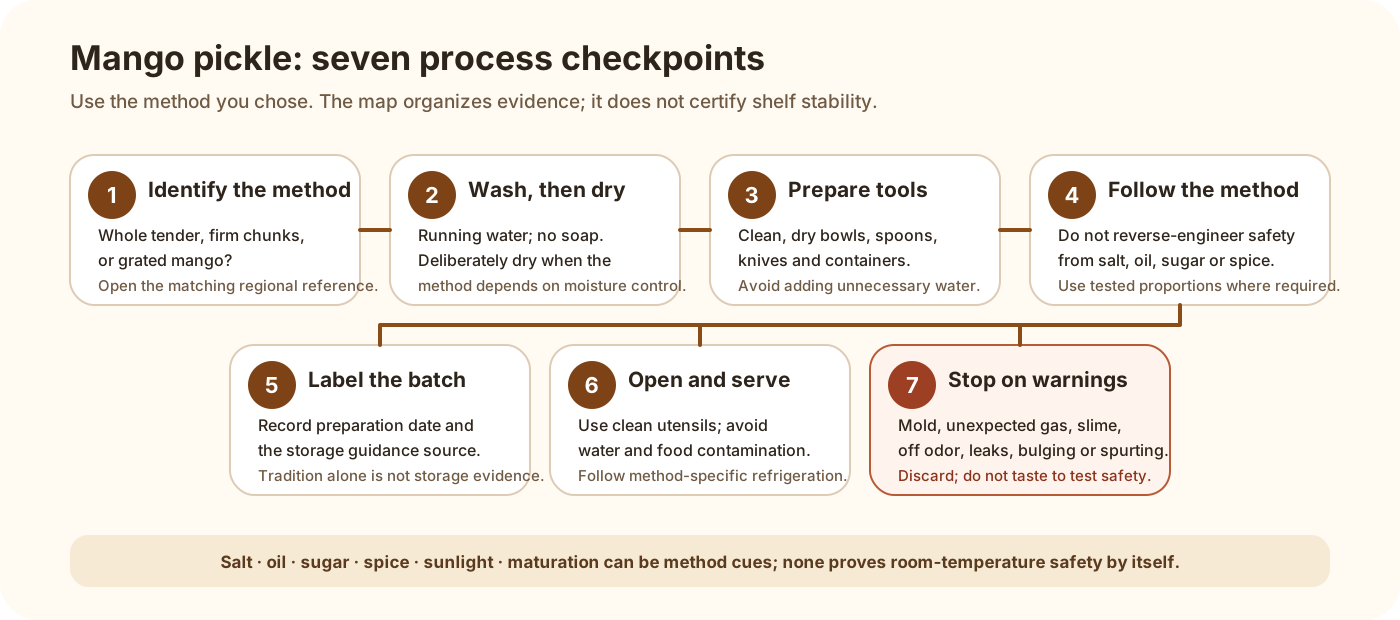
Use this original Pohabook process map as a quick visual rehearsal before mixing a batch. It follows the same evidence-bounded sequence as the printable checklist: identify the mango and method, wash and deliberately dry where moisture control matters, prepare clean dry tools, follow the exact method, record storage evidence, control contamination during opening, and stop when spoilage or abnormal-container warning signs appear.
Original Pohabook artwork created in-repository with no external image assets. It is a process reminder, not a shelf-life calculator or room-temperature safety certification.
Text fallback: mango form/method → wash and dry where required → clean dry tools/container → exact method/proportions → preparation date + storage evidence → clean serving/opened-storage practice → discard without tasting on concerning signs.
Carry the checklist into your kitchen notes
Copy a compact seven-step reminder for a family message, notes app, or batch-prep checklist. The copied note keeps the safety boundary: use the storage instructions from the specific regional method; this checklist does not certify shelf stability.
Traditional practice vs preservation evidence
Ask what a process cue actually proves
Cue you may see in an Indian pickle method
What it can tell you
What it does not prove by itself
Salt
It may be an important flavor, texture or preservation component in the exact method.
A generic safe room-temperature lifetime for an improvised batch.
Oil coverage
It may be a traditional handling feature in a specific regional preparation.
That a low-acid or oil-rich food is automatically safe without method-specific evidence.
Sugar concentration
It may define the culinary texture and process of a sweet mango preparation such as Chhundo.
That any home sugar ratio has been validated for ambient storage.
Sunlight / sun-curing
It may be a documented traditional maturation or concentration step.
A standardized canning process, acidity result, or universal shelf life.
Long maturation
It may be part of the expected culinary development of a particular pickle.
Safety simply because time has passed without an obvious problem.
Storage evidence handoff
Before you choose a shelf, fridge, or opening routine, answer four evidence questions
This is the bridge between making a pickle and deciding how to store it. It does not calculate shelf life or certify room-temperature safety. It helps you identify what evidence is still missing before you rely on a storage claim.
Original Pohabook reference visual. A familiar regional name or traditional ingredient is not, by itself, storage evidence.
1 · Which exact method did I follow?
Start from the specific regional deep reference, not a generic “mango pickle” label. Whole tender mangoes, grated mango, and chopped raw mango can belong to different systems.
2 · What does the source actually validate?
Separate culinary authenticity from preservation validation. NCHFP guidance makes acidity and tested proportions central when a pickled food is being treated as a validated shelf-stable process.
3 · Did I change a preservation-relevant proportion?
Changing water, vinegar or another acid, salt, sugar, oil, or the food-to-liquid ratio can invalidate assumptions borrowed from a tested process. Do not reverse-engineer safety from taste or appearance.
4 · What happens after filling and opening?
Record the actual refrigeration or opened-storage instruction for the method you used. A dry spoon reduces avoidable contamination; it does not turn an unvalidated preparation into a shelf-stable one.
Keep the conservative refrigerated lane. The cited Kerala Tourism formulation includes added water without validated final-acidity or shelf-stable-process evidence.
Tempering, spices or oil offset missing acidity/process validation.
Carry the storage questions into your batch notes
Copy a compact reminder before you fill the jar or decide where to keep it. The note contains questions and safety boundaries, not a shelf-life answer.
Nothing copied yet.
Stop-and-discard boundary: visible mold, unexpected persistent gas or foaming where fermentation is not intended, slime, off odor, leaking/bulging containers, spurting on opening, or unresolved safety uncertainty are reasons not to taste-test the food. Low-acid and oil-rich preparations, including garlic-in-oil style foods, require extra caution rather than reassurance from generic pickle rules.
Returning-user journey
Pair the checkpoint guide with your actual batch record
Regional culinary sources remain valuable for identity and technique. They do not override validated modern food-safety guidance where the two differ.
Privacy
The checkboxes are local to this visit
No account is required. This page does not save checkbox state to cookies, localStorage or sessionStorage. Reloading the page clears your checks. Printing uses your browser's normal print function.
We use optional Google Analytics only if you allow analytics storage. Essential site features work without it. See our Cookie policy.